Showing posts with label DSM. Show all posts

Thursday, June 15, 2017

The Arc of Therapy: Beginnings (Part 1)

Sven Scheuermeier
[Episode 110] Today's episode of the Social Work Podcast is the first of a three-part series on the arc of therapy – the beginning, middle and end.  In today’s episode I’m going to talk about the beginning phase of therapy. I'll talk about some conceptual issues like what do people want when they come to treatment, and how should you be with clients? I’m also going to review some of the more concrete aspects of the beginning of treatment like biopsychosocial and DSM assessment, talking about confidentiality and billing. I want this episode to be interesting whether you’re a first year social work student or a 35 year veteran of the field.

I’d like to thank TheraNest for sponsoring this three episode series. TheraNest is simple and affordable practice management software. To start your free 21-day trial and save 20% on your first 3 months, sign up at theranest.com/socialworkpodcast.


Download MP3 [46:28]


Monday, January 25, 2016

Critiques of the DSM-5: Interview with Jeffrey Lacasse, Ph.D.

[Episode 101] Today's episode of the Social Work Podcast is a critique of the  Diagnostic and Statistical Manual of Mental Disorders, 5th Edition: DSM-5.

The most basic critique of the DSM-5 is the same critique that has been levied against psychiatry for decades: that it does nothing more than medicalize or pathologize normal behavior. So is it ever ok to say that someone isn’t normal? Are there ever situations where giving a diagnosis is good? As it turns out, yes. And I’m not just talking about diagnosis as a means to finance treatment. Yes, third party reimbursement hinges on diagnosis. But I’m talking about something less institutional and more personal. There are people who like labels, who find comfort in being able to name or label what is wrong. The label draws a boundary around an experience. Labels can even draw up boundaries around a group of people. According to psychologist Gary Greenberg, “[the label] Asperger’s syndrome gave people whose primary symptom was isolation a way to belong and provided resources to those who were diagnosed” (Reese, 2013).

Download MP3 [37:19]


So, I know what you are wondering - is DSM diagnosis good or bad? Well, today’s episode won’t be the definitive answer to that question. But, it will give you cause to pause when you think about the role of DSM-5 in the professional life of social workers and the people we serve. My guest is social work faculty member from Florida State University, Jeffrey Lacasse, Ph.D. Dr. Lacasse has published several critiques of the changes in DSM-5. In today's episode, Dr. Lacasse critiques the definition of mental illness, the empirical support for and reliability of most diagnoses, the politics associated with the DSM and the implications for social workers who represent the single largest group of professionals who provide DSM diagnoses.


Friday, November 16, 2012

Proposed Changes in DSM-5: Interview with Micki Washburn, LPC-S and Danielle Parrish, Ph.D.

There’s an old saying, “What’s the fastest way to cure mental illness in an entire group of people? Get rid of the diagnosis.” The proposed changes to DSM-5 get rid of some diagnoses and add others. But that's not all. If you're like me, you have lots of questions about changes to DSM-5. When I posted the question “what would you like to know about the DSM-5” to the Social Work Podcast Facebook page 11 people responded in less than an hour and 20 people responded by the end of the day. So, what did they want to know? Jessica, Shelly, Sandy, Spring, Paul, and Suzannah wanted to know about autism, depression, and personality disorders. Shylah and Jen wanted to know about addictions. Lisa wanted to know what was up with ADHD. Ciarrai and Lyndon posed some great questions about the merits of DSM diagnosis in social work practice.

In today's Social Work Podcast, I speak with Micki Washburn, MA, LPC-S, NCC and Danielle Parrish, Ph.D. about proposed changes in DSM-5. We talked about the cross-cutting dimensional assessment, changes in the organization of the DSM-5, and changes in diagnoses such as ADHD, Asperger’s, Autism, Depression, Substance Use, and personality disorders.  We talked about some of the intended consequences such as greater accuracy for diagnosis, and some of the possible unintended consequences such as loss of funding for diagnostic-specific services.  We end with some thoughts about social work’s role in the new DSM.

Update: DSM-5 was published on May 27, 2013. Social work licensure exams in the USA (ASWB) required DSM-5 starting in 2015.

Tuesday, September 11, 2012

The Chronological Assessment of Suicide Events (CASE) Approach: Interview and Role Play with Shawn Christopher Shea, M.D.

[Episode 74] Today’s Social Work Podcast is an interview with Shawn Christopher Shea, M.D., developer of an approach to uncovering suicidal ideation and intent called the Chronological Assessment of Suicide Events (CASE) approach. In today’s episode, Shawn takes us through the CASE approach. He explains the value of assessing for suicidal content at different time points and emphasizes that eliciting suicidal ideation and intent is a difficult and sensitive topic. He talks about how moving through the CASE approach to help establish a therapeutic alliance and rapport with suicidal clients. He emphasizes the art of the interview, using validity techniques, and how we use words as central to uncovering suicidal ideation and intent. He talks about how the CASE approach is useful for any mental health provider. Shawn makes the argument that the CASE approach is an ideal approach to for assessing for suicidal risk that doesn’t sound like a pat suicide assessment. He emphasizes that the CASE approach is one-third of a thorough suicide assessment, the other two parts being identifying risk and protective factors, and the final part being developing a clinical formulation.
This figure represents the three components of a thorough suicide assessment. The CASE approach  provides a framework for assessing the information in the red square (ideation, plan, behaviors, desire, and intent).
Shawn has written that a thorough suicide assessment has three parts: 1) Gathering information related to risk factors, protective factors, and warning signs of suicide; 2) Collecting information related to the patient’s suicidal ideation, planning, behaviors, desire, and intent; and 3) Making a clinical formulation of risk based on these 2 databases. He writes that in the “clinical and research literature, much attention has been given to the first and third tasks (gathering risk/protective factors/warning signs and clinical formulation). Significantly less attention has been given to the second task—the detailed set of interviewing skills needed to effectively elicit suicidal ideation, behaviors, and intent. But in many respects, it is the validity of the information from the second component that may yield the greatest hint of imminent suicide.” (Shea, 2009, p. 1).

My interview with Shawn is a single episode in two continuous parts. In Part I Shawn and I talk about the CASE approach, including some of the validity techniques he has developed or uses to elicit suicidal ideation and intent. In the second part Shawn and I do a role play where he uses the CASE approach. 

Monday, August 13, 2012

Non-Suicidal Self-Injury (NSSI): Interview with Jennifer Muehlenkamp, Ph.D.

Today’s Social Work Podcast looks at the issue of non-suicidal self injury, or NSSI. According to the International Society for the Study of Self-Injury, NSSI is the intentional destruction of body tissue without suicidal intent and for purposes not socially sanctioned. I spoke with Jennifer Muehlenkamp, Ph.D., associate professor at the University of Wisconsin - Eau Claire, and one of the world’s leading experts in NSSI. In today’s episode, Jennifer and I talked about the definition of NSSI,  the intersection between suicidal and non-suicidal self-injury, and some things that clinicians should and should not do when working with clients who self-injure. We ended our conversation with some speculation on the future of NSSI as a stand-alone psychiatric disorder in the DSM-5.


Monday, November 17, 2008

Schizophrenia and Social Work: Interview with Shaun Eack, Ph.D.

[Episode 45] In today's podcast, I speak with Shaun Eack about schizophrenia and social work. We talk about some basic information that social workers need to know about the diagnosis of schizophrenia; Shaun identifies and describes the positive, negative and cognitive symptoms that are often present in people with schizophrenia. Around 13 minutes into the conversation we switch the focus from diagnosis to the role of the social worker in working with people with schizophrenia. We end our conversation with a discussion of treatment approaches, including a new approach that addresses cognitive content.

Tuesday, May 22, 2007

What is Pathological Gambling?

Today's podcast is the first in our four-part series looking at the DSM-IV-TR diagnosis of pathological gambling. In today's podcast, Jody Bechtold, LCSW, NCGC-II, PC looks at what it is, what it is not, and what are the similarities and differences between pathological gambling and substance use disorders.


Download MP3 [11:43]

Music: Money by Pink Floyd; Viva Las Vegas by Elvis, and Luck be a Lady by Frank Sinatra.

This series on pathological gambling includes the following podcasts:

  1. What is Pathological Gambling? [11:43]
  2. Treatment of Pathological Gambling [27:00]
  3. Thinking Like a Pathological Gambler: Illusions of Control / Chance vs. Skill [8:54]
  4. How to Become a Nationally Certified Gambling Addictions Counselor [27:53]
Updates:

APA (6th edition) reference for this podcast:

Singer, J. B. (Host). (2007, May 22). What is pathological gambling? [Episode 17]. Social Work Podcast. Podcast retrieved Month Day, Year, from http://socialworkpodcast.com/2007/05/what-is-pathological-gambling.html

Monday, March 19, 2007

Cognitive-Behavioral Therapy (CBT)

[Episode 14] In today's podcast, we're going to talk about the therapies that take a cognitive-behavioral approach to working with people. I review the theoretical assumptions, therapeutic process, techniques, use in culturally competent practice, and strengths and limitations of CBT. This podcast is longer than most because I use a lot of clinical examples and dialogue to illustrate the concepts. [Pictured: Tim Beck, developer of CBT, and Albert Ellis, develop of REBT]


Download MP3 [47:11]

Thursday, March 1, 2007

Developing Treatment Plans: The Basics

[Episode 11] In this podcast I cover the basics of problem definition, developing goals and measureable objectives as well as identifying interventions and strategies. The key to good treatment planning is making sure that there is a clear and logical relationship between your assessment, problem formulation, goals, objectives and interventions.
Download MP3 [16:34]


Transcript

Monday, February 26, 2007

Interpersonal Psychotherapy (IPT)

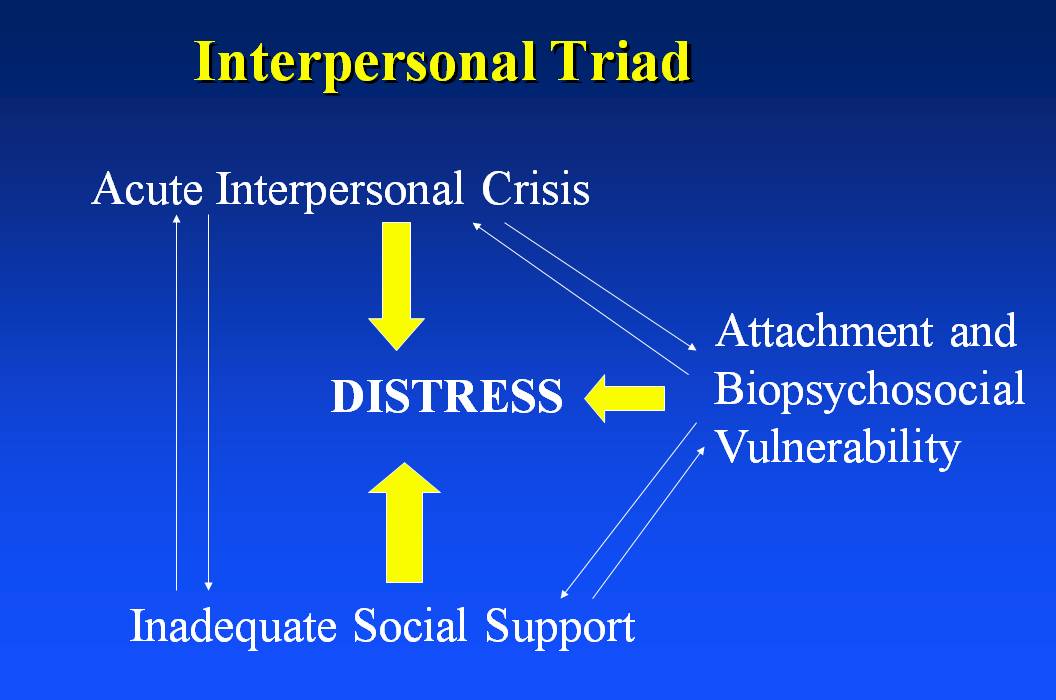
[Episode 10] In today's lecture I will will focus on some of the key concepts of IPT, the role of the therapist and client, the structure and goals of IPT - specifically focusing on grief, interpersonal role dispute, role transition and interpersonal deficits, and some of the techniques used in IPT. I'll end with a brief discussion of the applications of IPT, its strengths and limitations.

IPT is a time-limited psychotherapy that was developed in the 1970s and 80s as an outpatient treatment for adults who were diagnosed with moderate or severe non-psychotic, unipolar depression. Over the last 30 years, a number of empirical studies have demonstrated the efficacy of IPT in the treatment of depression. Although originally developed as an individual therapy for adults, IPT has been modified for use with adolescents and older adults, dysthymia, bipolar disorder, bulimia, anxiety disorders and couples counseling. IPT has its roots in psychodynamic theory, but differs from the latter in that it focuses on improving interpersonal functioning in the present. It is similar to CBT in its time-limited approach, structured interviews and assessment tools, but also differs from CBT in that it focuses on the client's affect, rather than cognitions, and the development of a more supportive social network. And whereas nearly all CBTs use homework as a standard part of treatment, although Brief ITP (ITP-B) uses homework, regular IPT may not.

Monday, January 22, 2007

Bio-psychosocial-Spiritual (BPSS) Assessment and Mental Status Exam (MSE)

[Episode 2] This is the second part of a two-part lecture on diagnosis and assessment. In the first episode I reviewed the history of the DSM and the multiaxial system. In this lecture, I discuss the Bio-psychosocial-spiritual (BPSS) assessment as the means for providing context for the client's presenting problems. I discuss the purpose of each of the four life domains and how the information is used in social work practice. Emphasis is placed on solution-focused approaches to assessment. I end with a brief description of traditional format for organizing observations about the client - the Mental Status Exam.


Download MP3 [17:40]


DSM Diagnosis for Social Workers

[Episode 1] This is the first part of a two-part lecture on diagnosis and assessment. The Bio-psychosocial-spiritual (BPSS) assessment and the DSM diagnosis are the two most common types of assessments made by social workers. In this lecture, I briefly review the history of DSM diagnosis, from the creation of the first ICD in 1900 to the most recent text revision of the DSM-IV in 2000. I discuss the multiaxial system and provide examples. I transition from DSM diagnosis to the BPSS assessment by discussing the similarities and differences between the two assessments.

Download MP3 [24:26]